
Writer's Journal #5
On Vertov's "Man With A Movie Camera" and The Mass Ornament

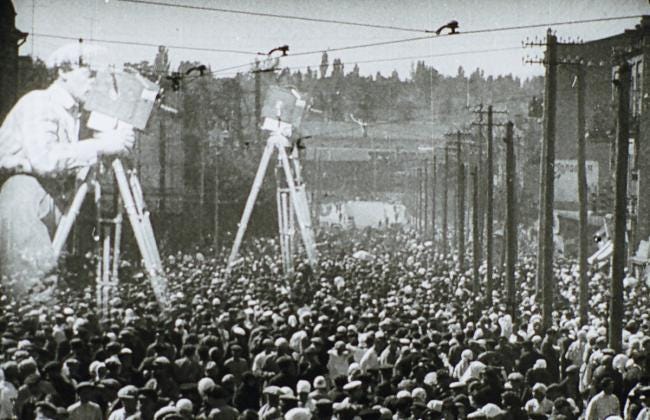
This was originally written for a course, but I thought that I might as well publish something short so as to give myself an excuse to publish some new material and, though ill-advised, provide myself some minor respite from the arduous task of completing my finals. Though not my best work, there is something to be said for attempting to condense complex and oftentimes dense arguments into digestible packages.
In the written accompaniment to his seminal documentary “Man With A Movie Camera”, the pioneering Soviet documentarian Dziga Vertov presents an account of filmmaking that, despite being almost a century old, remains decidedly revolutionary. Vertov holds that the sole job of filmmaking, rather than to remain within the “little fake world of the film-factory” and the pitiful facsimiles of ‘reality’ it aims to produce, is to embark on an attempt to capture the rapturous, if often bewildering, totality of modernity. This endeavor is to be embodied by that of the cameraman who, in pursuit of capturing reality, is forced to employ all of his cognitive faculties in order to keep pace with the fleeting phenomena of modern life. The camera, which was previously rendered immobile within the film-factory, is to become the conduit, through means of dynamic action and a myriad of sophisticated techniques, by which to capture reality. Much like the cameraman operating it, it is to recede into the background and, by doing so, become implicated in the very processes it intends to capture. The consummation of this endeavor, Vertov concludes, will be the visual distillation of the totality of Soviet society and, by extension, the liberation of filmmaking from the dictates of capitalist production.
Often heralded as not only his finest achievement, but amongst the defining cinematic works of the previous century, “Man With A Movie Camera” remains Vertov’s clearest articulation of this aforementioned approach. In his pursuit of a totalizing account of early Soviet life, Vertov can be understood as satisfying the demand, first articulated by Walter Benjamin, to successfully coax out the revolutionary potential of new forms of expression associated with industrialization. Despite being greatly informed by his steadfast adherence to socialist principles, Vertov’s revolutionary tendencies are best exemplified within the film through his dynamic manipulation of the camera. I argue that this particular approach to cinematography, which dissolves the formal rigidity associated with the aesthetic condition outlined by Sigfried Kracauer in his writing on the mass ornament, is capable of formulating a novel form of filmmaking that, through a visual mimicry of the dynamics the “industrial metropolis”, transcends the tendency towards rationality and order associated with industrial capitalism.
As stated previously, the dynamism of Vertov’s cinematography appears to challenge the prevailing aesthetic condition, referred to as the mass ornament by Sigfried Kracauer, associated with industrial society. According to Kracauer, the mass ornament entails a phenomenon whereby the logic of industrial economic production comes to dictate the formal character of artistic expression. This condition is thought to manifest itself through a conspicuous attempt to visually mirror the mechanistic repetition of movements necessitated by the mass production of commodities, thereby subordinating aesthetics to the “rationality to which the prevailing economic system aspires”. This condition is thought to be epitomized by the Tiller Girls, a dance troupe whose highly orchestrated performances produce “indissoluble girl clusters” animated by the precise, frictionless movement of arms and legs. For Kracauer, the formalized regimentation of movement has the effect of “emptying all the substantial constructs of their contents”, rendering such performances incapable of articulating anything beyond that of an aestheticization of industrial activity.
Vertov’s cinematography, though bearing a considerable resemblance to the mechanistic aesthetics associated with the mass ornament, is capable of transcending them through a conscious embrace of dynamic movement. This is best expressed through Vertov’s extensive application of montage within Man With A Movie Camera. According to Carsten Strathausen, montage functions to depict modern life “as a rapid succession of disparate and incoherent images”. By doing so, Vertov aimed to “capture the essence of modern urban experience”, effectively emulating the “spatial incoherence and disorientation” considered characteristic of the industrial metropolis. This parallels the assertion, made by Leo Charney and Vanessa Schwarz, that “modern culture was ‘cinematic’ before the fact”; the freneticism of the industrial metropolis is mirrored in the deluge of visual stimuli thought to epitomize the aesthetic character of cinema. As such, Vertov’s film can be understood as an attempt to preserve the complex dynamics inherent to modern life within artistic expression, thereby establishing a structural homology between city and cinema not beholden to the rationalizing impulse associated with the aesthetic condition of industrial capitalism.
Song(s) Of The Week:
If the above writing proved needlessly convoluted, intellectually shallow or borderline incomprehensible for your liking, I hope these songs will prove otherwise. Enjoy!
Erika de Casier, “Photo Of You”
Jawnino, “Dance2”